
Teaching multilingual children is a gift. It’s truly a joy. In my own classroom, I learned so much from my students, especially those that spoke more than one language.
Over the years, one thing I learned from experience as well as through professional learning is that each student deserves to be seen and served individually. No one size fits all approach works. While differentiation may seem daunting, it’s actually not that scary. Dr. Stephen Fleenor describes differentiation as “not creating individualized lessons...it is creating environments in which students at all different levels, all different proficiencies...can each thrive and each grow one level up in that lesson”. Dr. Fleenor offers two wise suggestions for creating of environments that offer differentiation:
Over the years, one thing I learned from experience as well as through professional learning is that each student deserves to be seen and served individually. No one size fits all approach works. While differentiation may seem daunting, it’s actually not that scary. Dr. Stephen Fleenor describes differentiation as “not creating individualized lessons...it is creating environments in which students at all different levels, all different proficiencies...can each thrive and each grow one level up in that lesson”. Dr. Fleenor offers two wise suggestions for creating of environments that offer differentiation:
- Offering open ended guided questions
- Providing time for students to share and discuss in small groups
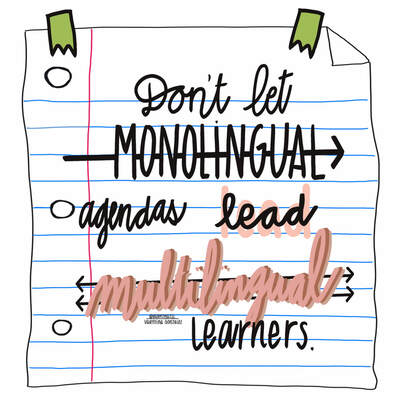
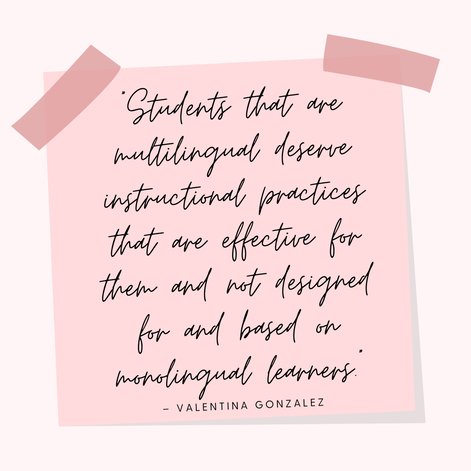
Equity and justice in education are paramount. MLLs are entitled to grade level curriculum with support needed for accessing it successfully. Meaning it’s not enough just to deliver the instruction. Students that are multilingual deserve instructional practices that are effective for them and not designed for and based on monolingual learners. When teaching multilingual children is led through monolingual agendas equity and justice are at risk.
Differentiated instruction for multilingual learners (MLLs) is necessary. Let's examine a few key ideas.
- Multilingual children are not monolingual. First and foremost, being multilingual means speaking or understanding more than one language. Some students may be emerging multilinguals (still acquiring an additional language). The mere fact that a learner is multilingual gives enough reason to make sure they receive instruction that meets their needs. In his book, Math for ELLs, Jim Ewing asks us to imagine being told you could no longer use your right hand. For left handed people, that may be just fine. But for those that are right handed, this may pose a challenge. He pushes us to think about how our writing and drawing may come out and how it may appear to others. It may seem as if we were less capable when actually we are differently able.
- Students that are adding a new language are working hard and using additional brain power. They are not only learning content. They are also acquiring new vocabulary and language structures. This requires support from educators and takes time and lots of energy on the learners’ part. While monolingual students may only need to hear or read new information to learn academic content, multilingual learners may need to translate, process, and discuss for comprehension. They also may need additional support to receive new information, such as videos, images, audio, etc.
- Culture affects how we navigate the world around us. In some homes it is traditional and part of the culture to talk to children a lot and about all things while in other homes that is not part of the culture. In some homes it is traditional and part of the culture that people work together while in others independence is --. In some homes it is traditional and part of the culture to wait for your turn to speak while in other homes speaking is more fluid. What is learned and lived at home comes into everyday life and inevitably into classrooms.
- Background knowledge and experiences contribute to how students learn. Multilingual Learners often have lived experiences that differ from monolingual learners’. Lived experiences serve to build background. While a monolingual student in the classroom may have vast knowledge on a particular subject, a multilingual learner may not have had the same opportunities. I recall as a student myself in elementary school trying to read a text on baseball. I was completely confused. Baseball was not a sport played in Yugoslavia when my parents grew up, so when we moved to America, we were unfamiliar with the sport. Reading about it made me feel like I couldn’t read. I was stuck on manipulating not only the words but also the vocabulary. I came across words I had never heard and ideas that didn’t make sense to me (strike out, home run, foul ball, etc.).
Lessons and instruction for multilinguals should not be like hand-me downs from older siblings. We should not have to adjust them, patch them, tweak them, tailor them to make them fit the children that need them now. No, instead, lessons and instruction should always be language-rich from the start, filled with opportunities that invite children of all cultures to grow and show who they are.